
How to Diversify for Deflation – Part 5
Credit: Ideas contributed by Esra S.

Part 1 of this series on deflation discussed why it is unthinkable. Part 2 discussed why a protracted deflation would be an utter disaster. Part 3 discussed why governments can’t fully control deflation. Part 4 discussed deflation despite government stimulus and “reset” scenarios. In this final installment, we explore practical ways to diversify ourselves for deflation.
Getting Our Minds Right about Deflation
First and foremost, we need to open our minds to the possibility of deflation and get serious about it. Did you know that Berkshire Hathaway (formerly run by the “Oracle of Omaha” Warren Buffet) now has a $365B cash hoard as of Q2 2026 (about 30% of its holdings)? Berkshire is betting on deflation – are you?
Second, we need to get serious about a biblical level of diversification. In Genesis 41, God used Joseph to warn Pharoah of seven fat years, followed by seven lean years. Joseph had the luxury of certainty and timing, which allowed him to methodically prepare. Similarly, we know economic down cycles consistently happen. We also know that Solomon warned that we “do not know what disaster may come upon the land.” Ecclesiastes 11:2b. Are you humble enough to forgo some potential gains to protect yourself? Learn this investing axiom: pigs get fat, and hogs get slaughtered.
Third, we need to understand that the cyclical nature of the economy was planned for in God’s law (the Torah). God designed the Israelite society to engage in a periodic deflationary cleanse; it was known as the Year of Jubilee, where family property ownership was restored every 50 years amongst other economic and agricultural resets (Leviticus 25:8-55). This was God’s way of preserving a lasting, stable society. The modern take away is that inflationary imbalances naturally build to a point where deflation becomes inevitable, whether in a planned reset or a chaotic deflation.
Why It’s Difficult for Individuals to Prepare for Deflation
Like fish, who are not conscious that they swim in water, our society swims in and breathes debt, which has been ever-expanding. It is very hard to emotionally and intellectually prepare for something as counterintuitive as deflation. In 1929, at the end of the Roaring Twenties with the stock market at all-time highs, 99% of people could never have imagined what was to come; however, I’m sure people felt that something was off.
As outlined below, preparing for deflation involves much more than buying physical gold and silver. Because dollars and dollar debts become more valuable in a deflation, it turns conventional thinking on its head. As with other forms of diversification, preparing for deflation will cost you. If deflation happens, you’ll be glad you prepared (like buying insurance); if it doesn’t, that’s even better. No one buys fire insurance hoping their home burns down.
Practicals: Preparing for Deflation
Here are some things a person or family might do to prepare for a deflationary episode:
Increase your cash or cash-equivalent positions (e.g., short-term government bonds, high-yield savings accounts). To do so, you might need to sell some assets or stop buying them to build up cash reserves. This runs counter to common sense (i.e., “cash is trash”). But if massive deflation strikes, you’d be very glad you shifted some of your assets to cash; in deflation, cash is king. It buys you time, so you aren’t forced to liquidate your assets at low price levels; if you have enough cash, you’ll have the flexibility to buy assets on the cheap (like Berkshire Hathaway).
Similarly, consider paying off debt, even low-interest debt. This also runs counter to common sense in our inflationary world. Paying off a 3%, 30-year mortgage doesn’t make sense when savings accounts are paying 4%, unless you are anticipating a sustained deflation. Such a strategy only makes sense if you can pay off the entire mortgage to free up cash flow. Instead of paying off low-interest mortgage debt, I personally take the approach of saving more cash and earning a higher interest rate on it (e.g., 4%).
Consider holding longer-term government bonds (e.g., 3, 5, or 10-year bonds). These are terrible to own in a heavy inflation scenario, so only consider having a small percentage of your holdings here. In a sustained deflation, the bonds will appreciate while you collect a yield. Honestly, this option is the hardest for me to get behind, because it feels like locking in losses for many years.
Hold ample physical gold and silver. Amazingly, these protect against deflation, stagflation, and hyperinflation. When faith in banks and other financial institutions is shaken, people and governments alike flee to what they can hold in their hands. In hyperinflation, gold goes to infinity. In deflation, gold increases in value (e.g., physical gold went up by 66% in the 1930s on top of the deflationary purchasing power increase).
If most of your wealth is locked up in your home’s equity, consider balancing some of your wealth into cash (to save, not to spend) via a lower-interest HELOC. In a deflation, home values plummet and employment dries up (a potential catastrophe if you are hit by both, which happened to many in the Great Recession). Consider downsizing or pulling out some equity to put into safe cash equivalents (i.e., expand your emergency fund). I understand these are very difficult things to do just to prepare for a potential deflation that may never come. This option is something to consider only if you have very little financial flexibility (“house poor”).
Consider moving money into more solid banks. This also goes for institutions holding your insurance, annuities, stocks, bonds, and other financial instruments. Deflations are notorious for bankrupting banks and other seemingly solid institutions. Even insurance companies and stock brokerages are not immune from bankruptcy. FDIC and SIPC insurance will not be able to cover losses in a system-wide deflationary bust. Spend some time researching which institutions are more solid. Why not have your funds in safer institutions?
For those with considerable fortunes, consider holding some physical cash in private depositories (maybe even outside of your jurisdiction). Think of it like a bank that you pay interest to in exchange for systemic risk protection; if you are wealthy enough, this level of diversification is worth it.
It is difficult to know if you’ve prepared enough for deflation, but at a bare minimum, I would have 6-24 months of your family’s living expenses in cash equivalents earning interest (i.e., a large emergency fund), depending on your specific situation. I would have at least 10% of your investable assets in physical gold and silver. Of course, too much preparation for a deflation is not good, because it is too costly in our mostly inflationary world.
Extra Insight: Gaining Investing Perspective by Evaluating the State of the Economy with the Quadrant Paradigm
Some economists and investors view the economy as being in one of four general states at any given time, which gives them a framework for investing. One on axis, you have growth in the economy, and on the other, you have inflation (or deflation).
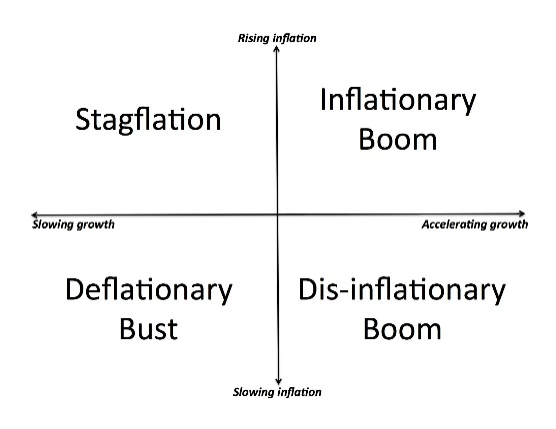
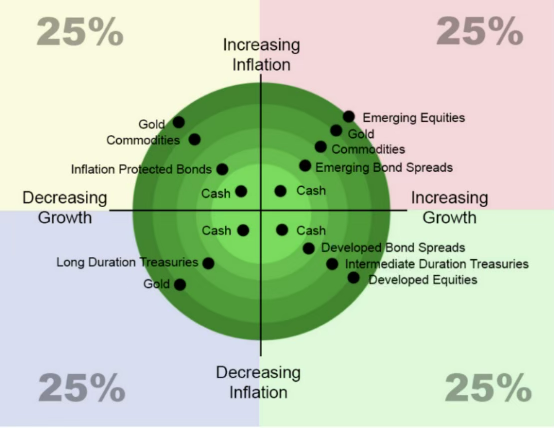
The quadrants are: 1) inflation/expansion, 2) disinflation, 3) stagflation, and 4) deflation, which provides a general framework for which assets perform well under different conditions. As you can see, gold and long-duration treasuries perform well in deflation, with cash as the bridge to transition from one quadrant to another.
Summary and General Bias Toward an Inflationary Endgame
“Since no one knows the future, who can tell someone else what is to come?” -Ecclesiastes 8:7
“It’s tough to make predictions, especially about the future.” – Yogi Berra
While I believe it is more likely that we will experience hyperinflation rather than deflation in the long run, it is still important for people to prepare for deflation. I believe the most likely scenario is that we will encounter a limited deflationary episode (like the 2008 Great Recession or worse) and then lurch into hyperinflation after world governments’ stimulatory responses. But I can’t predict the future – and neither can you. “You do not know what disaster may come upon the land,” (Ecclesiastes 11:2b), so we should diversify, at least to some degree, for deflation.
For further study, here is a list of Scriptures on investing. For a broader spiritual view on investing, inflation, deflation, and other topics, read Faith and Finances or do the Building Faith and Finances course.