
Governments Can’t Fully Control Deflation (On a Knife’s Edge) – Part 3
Part 1 of this series on deflation discussed why it is unthinkable. Part 2 discussed why a prolonged deflation would be an utter disaster. Here, we look at why governments can’t fully control deflation and how the money system is really on a knife’s edge.
Such is the destiny of all who forget God;
so perishes the hope of the godless.
What they trust in is fragile;
what they rely on is a spider’s web.
They lean on the web, but it gives way… Job 8:13-15
Governments and Their Central Banks Can’t Fully Control the System
The United States allowed for the creation of its third central bank, the Federal Reserve, in 1913. Ironically, it is neither federal nor has any reserves (it is privately owned and has no gold). The entity was supposedly created to stop banking panics (bank runs). However, after its creation, it promptly expanded the money supply which caused the Roaring 20s and the subsequent 1929-1939 Great Depression.
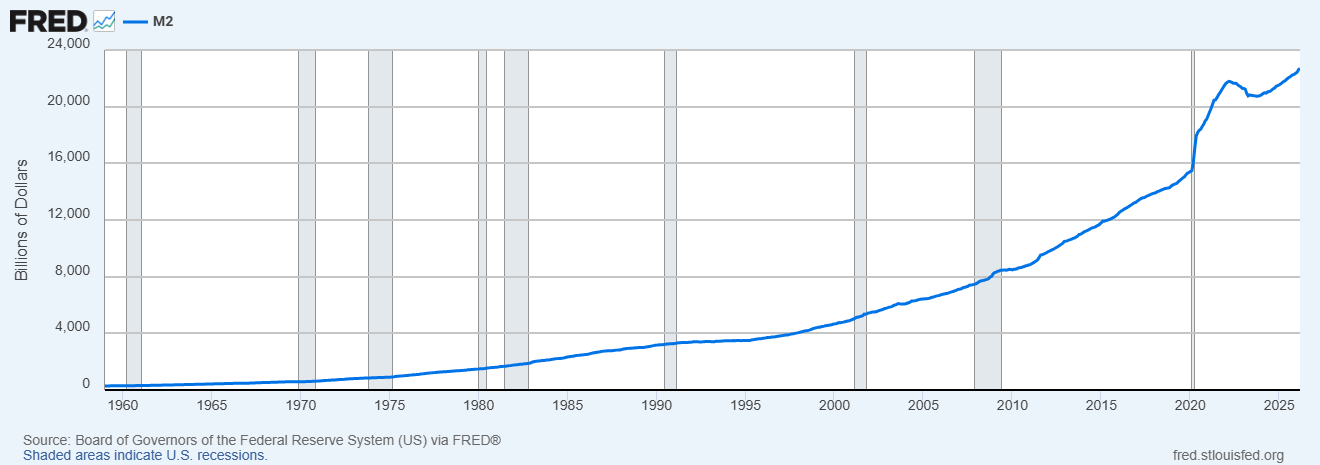
For the last 86 years, the Fed and Treasury have managed to avoid another Great Depression by continually expanding the money supply, though we had a big scare in 2008. Since that time, the money supply (debt) has been expanded exponentially (see the chart of M2 above, a common measure of the money supply currently approaching $24T). The larger the money supply (debt), the more debt needs to be continually created to support it. This is the nature of any fiat money system.
As debt increases, the potential for a deflationary bust increases – as well as its potential severity. Once you know that, you can understand why global debt went from millions to billions to trillions (and quadrillions when counting derivatives). New, ever more sophisticated mechanisms to control the money supply have been consistently implemented, which create massive economic distortions (most notably, income and wealth inequality).
Much like avoiding a nuclear war, governments are squarely focused on avoiding a deflationary bust, because failure would be catastrophic. The inflationary bias works very well for politicians, because they can use the newly created money (debt) to fund whatever seems politically expedient. The public only puts up with inflation because it is subtle (i.e., an invisible tax). Politicians and voters alike participate in this destructive, short-term thinking, which causes long-term detrimental effects. Deflation becomes an unthinkable situation that policy makers and the public avoid at all costs.
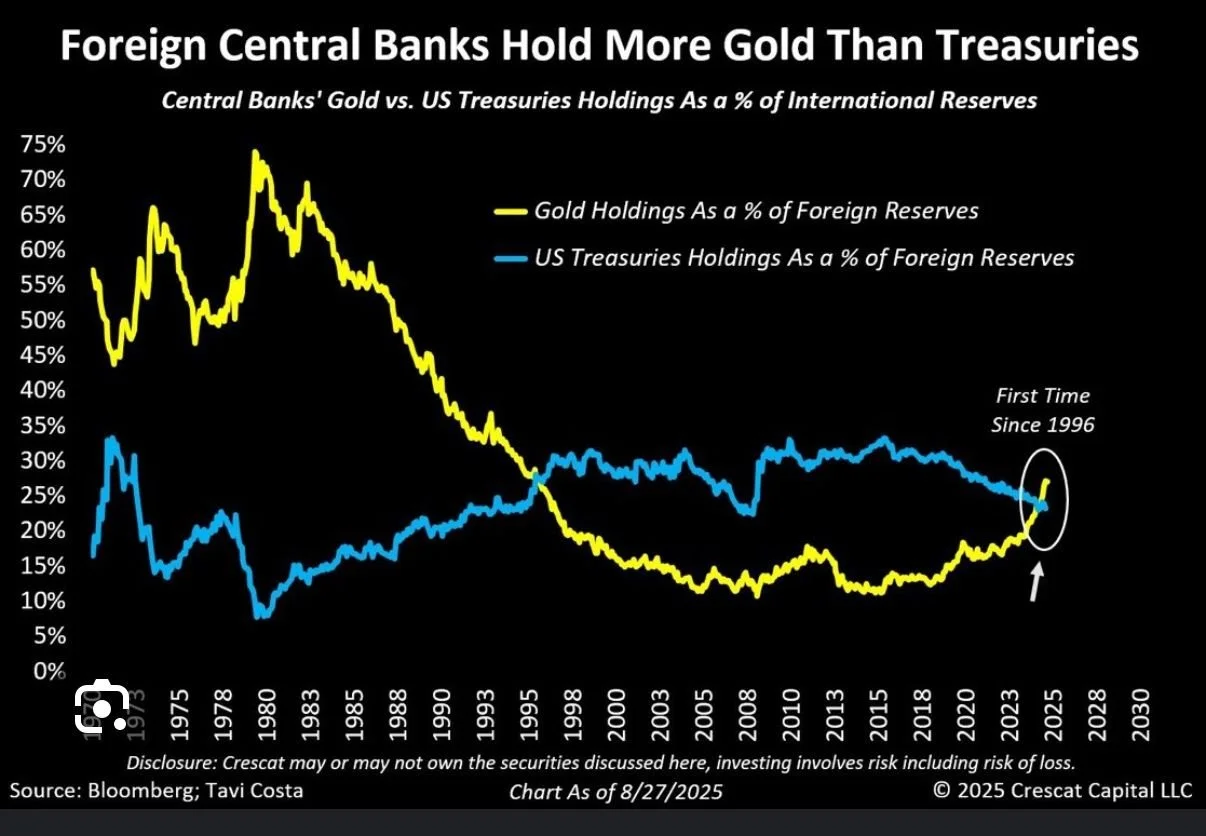
Central banks prepare for both inflationary and deflationary calamities by purchasing physical gold and keeping it in their own local vaults. When the current fiat money system fails, gold will most likely be the backstop for a loss of confidence and the basis upon which a new monetary system will emerge. The fiat monetary failure will either occur by hyperinflation or by extreme deflation; how and when it will unfold is truly unknown, but I believe the system will need to be “reset” at some point.
Deflation would bring currencies’ value to painful highs and bankruptcy to most people and companies; eventually currencies’ value would reach equilibrium at a sensible level that more accurately matches physical reality (although very painfully and chaotically). A hyperinflationary bust is the mirror image of a deflationary depression, where money loses all value and gold, silver, and other barterable commodities (perhaps Bitcoin) return as day-to-day money. In my opinion, the deflationary outcome is more honest and natural, but much less likely because of political dynamics.
Both outcomes lead to economic devastation, a loss of confidence in the system, and a return to sound money (all roads lead to gold). Gold is not the panacea some might imagine, because it is inflexible compared to unbacked money (i.e., it can’t be conjured up at the push of a button). However, it is divisible, fungible, durable, portable, widely accepted, viscerally attractive, and has no counterparty risk. These qualities make it trustworthy and useful money.
Gold isn’t perfect for many reasons, especially because it isn’t easy to transact with in our modern world. Many technological solutions can apply to gold, where gold is the base (e.g., gold tokenization, gold ETFs, central bank gold ledgers with periodic transfers). I doubt we will ever see physical gold being widely used for retail transactions, but I strongly believe we are headed back to a gold-backed world. When the pain of fiat economic failure becomes so great, the populus will finally be willing to elect politicians with longer-term solutions, like reducing government spending (e.g., Javier Milei in Argentina) and restoring sound money.
In my opinion, whether we end up in a hyperinflation or a deflationary bust, depends on how aggressively the money supply is inflated. While the long-term outcome is, in many ways, the same, the process is very different. The deflationary depression of the 30s had very different dynamics than the heavy inflation of the 70s (or various hyperinflations in different countries). In the next article, we’ll look at why we could have a deflationary depression, even though the authorities can easily print money.
For further study, here is a list of Scriptures on investing. For a broader spiritual view on investing, inflation, deflation, and other topics, read Faith and Finances or do the Building Faith and Finances course.